Active Acne or Acne Scars? Sort It Out First
Active acne and settled scars call for different plans. Learn how microneedling differs from RF microneedling and what the FDA notice of 15 October 2025 does and does not say.
Published by Beauty Blossom
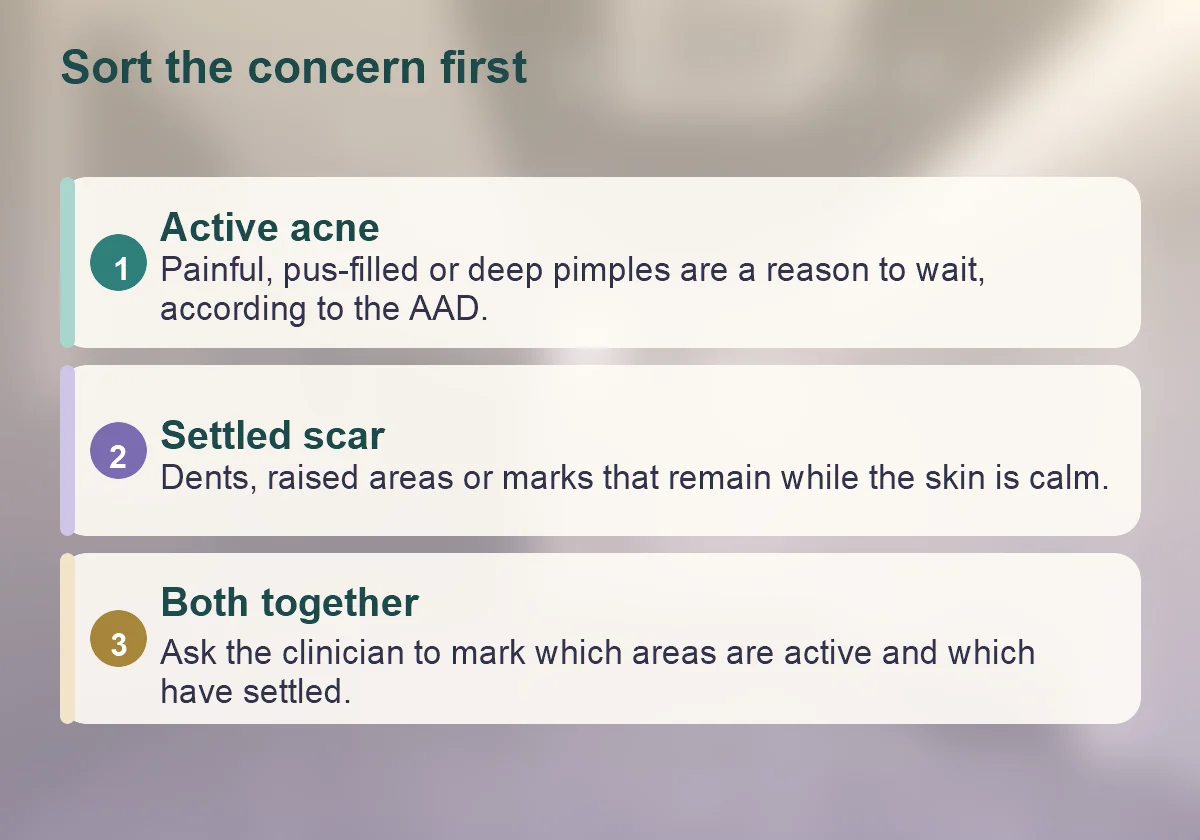
Active acne and acne scars are different problems, so they need different plans. Active acne is inflammation that is still happening. A scar is a change the skin keeps after a spot has healed. The American Academy of Dermatology (AAD) says pimples that are painful, contain pus or go deep are a reason to wait before microneedling, so the first job in a consultation is working out which situation you are in.
Active acne or scar: what are you looking at?
Sort the concern before comparing devices. Only an examination can confirm it, but this table shows how the two groups are usually separated.
| Question | Active acne | Established scar |
|---|---|---|
| What it is | Inflamed pimples that still appear, swell or hurt | A lasting change in colour or texture after a spot has healed |
| What you notice | Tenderness, pus, deep lumps, new spots | Skin that feels uneven or looks marked even when no new spots are appearing |
| First planning question | What is controlling new breakouts? | Is the mark flat colour, a dent or a raised area? |
Many people have both at once, so ask the clinician to point out which areas are still active and which have settled.
Microneedling and RF microneedling are different methods
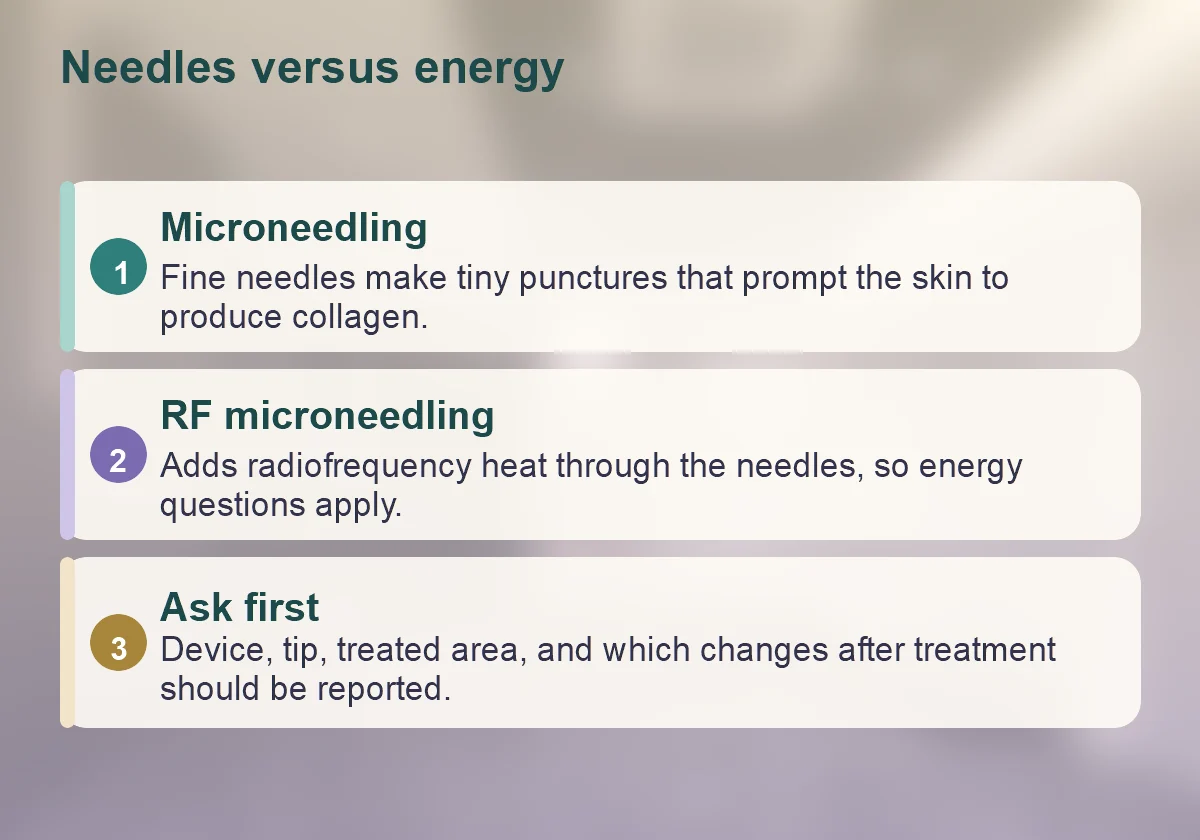
Standard microneedling uses fine needles to make tiny punctures that prompt the skin to produce collagen. The AAD describes RF microneedling as the same idea with heat added, travelling down the needles. The FDA describes RF microneedling devices as arrays of small electrodes that deliver radiofrequency energy into and under the skin to produce local heating.
That changes your questions. With plain microneedling you ask about needles. With RF microneedling you also ask about energy: which device, which tip, and how the clinic decides where heat is delivered.
What the FDA notice of 15 October 2025 covers
This is United States guidance, not a ruling on approval in Korea. The FDA reported serious complications with certain uses of RF microneedling devices in procedures meant to treat wrinkles or produce skin effects such as resurfacing, tightening or rejuvenation. Reported problems include burns, scarring, fat loss, disfigurement and nerve damage, and the FDA says its evaluation is ongoing.
The notice asks patients to discuss benefits and risks, ask which devices a provider plans to use, choose a licensed provider with training and experience in RF microneedling, and not use these devices at home. If something worries you after any RF microneedling procedure, the FDA advises seeking care from a licensed health care provider. The notice does not say every RF treatment causes harm, and it does not declare any treatment safe.
Tell the clinic before anything is planned
The AAD lists situations where microneedling should not be done or should wait. Raise any of these:
- Pimples that are painful, contain pus or go deep, or a skin infection
- A recent tan or sun exposure
- Isotretinoin use, now or in the past
- A history of keloids, or slow or poor healing
- A weakened immune system, radiation treatment, or skin cancer treatment in the area
Also ask what to pause beforehand. The AAD notes that preparation can involve stopping retinoids and protecting skin from the sun, so follow the clinic's own instructions.
Questions that keep the consultation specific
- Which marks are you treating, and which areas are still active?
- Is the plan plain microneedling or RF microneedling, and which device will be used?
- What is that device's regulatory status for use in Korea?
- Which changes after treatment are expected, and which should make me call you?
- How does follow-up work if I travel home?
Beauty Blossom's menu includes a Potenza RF page. For its settings, its regulatory status in Korea or the clinic's protocol, ask the clinic directly.
FAQ
Can RF microneedling be done while I still break out? That depends on an in-person assessment. The AAD says painful, pus-filled or deep pimples are a reason to wait, so expect the clinician to check how active your skin is first.
Does the FDA notice mean RF microneedling is banned? No. The notice raises awareness of reported complications, and the FDA says it is working with manufacturers while it evaluates the issue. It also describes these devices as Class II devices cleared through the 510(k) process in the United States. It does not tell you how a device is regulated in Korea.
Is a home microneedling tool the same thing? No. The AAD warns that at-home devices can irritate skin, sometimes pierce it, and carry risks of infection or scarring. The FDA says RF microneedling should not be used at home.
Sources
- American Academy of Dermatology: Microneedling to fade scars
- U.S. FDA: Potential Risks with Certain Uses of Radiofrequency (RF) Microneedling, safety communication, 15 October 2025
Clinic information and contact
For treatment details or appointment enquiries, use the clinic's official channels.
Location
Beauty Blossom Clinic
66 Yanghwa-ro, Mapo-gu, Seoul, Republic of Korea (6th and 8th floors)
Individual results may vary.
Back to Blog →