Why the Same Unit Count Does Not Mean the Same Botulinum Toxin Dose
Botulinum toxin units describe biological potency within a particular product and assay. Understand why matching numbers across brands cannot establish an equivalent treatment.
Published by Beauty Blossom

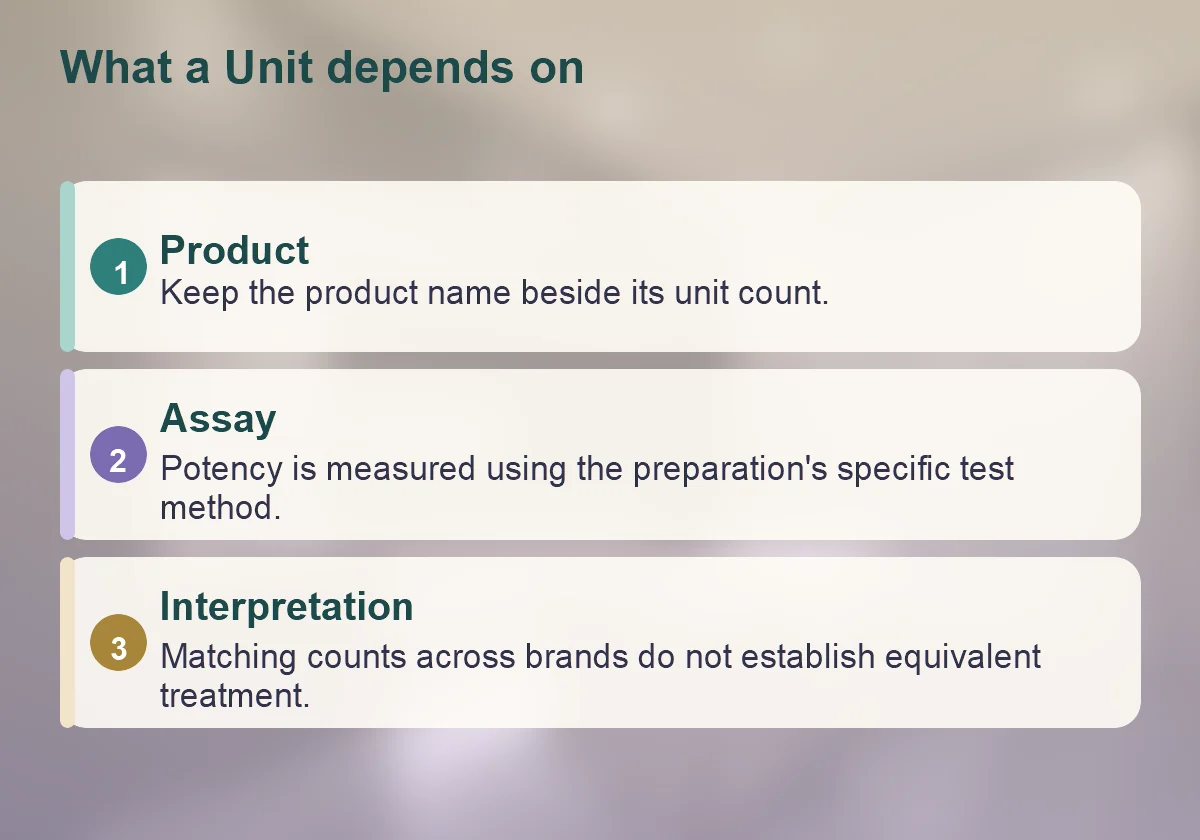
The same unit count on two botulinum toxin products does not establish the same dose or effect. A Unit measures biological potency using a method specific to the preparation. It is not a universal measuring scale shared by every brand. The US prescribing labels for BOTOX and XEOMIN explicitly warn that their units cannot be compared with or converted into units of other botulinum toxin products.
What a potency unit actually describes
Biological potency means activity measured in a biological test. An assay is the test method used to assess that activity. Unlike a physical unit such as a millilitre, the meaning of a botulinum toxin Unit depends on the product and its assay. The product name therefore belongs beside the unit count; removing it leaves out information needed to interpret the number.
This distinction is about measurement, not a ranking of brands. A count cannot, by itself, show that one preparation is stronger, safer or more suitable. Nor does a similar name for the active treatment establish a common scale. The labels describe product-specific potency rather than a shared currency that patients can exchange between brands.
Why matching numbers is not matching treatment
If two treatment descriptions show the same number of Units but name different products, the matching digits are not evidence of equivalent treatment. A larger count on a different product is also not proof of a better result. Both comparisons assume that the numbers were measured on an interchangeable scale, which is precisely what the label warnings reject.
| Information | How to interpret it |
|---|---|
| Product and Units | Read together as a product-specific potency description. |
| Matching counts across brands | Do not establish equivalent doses or outcomes. |
| More Units | Do not independently establish a better treatment. |
A clinician changing products must make a product-specific treatment decision. Reusing a number from an old appointment, or applying a ratio found online, bypasses that decision. Keeping the old product name and treatment record is useful; using them as a self-conversion instruction is not.
Volume is a different measurement
Millilitres describe the volume of liquid. Units describe biological potency for the named product. The liquid volume alone does not identify the product or establish how much potency is being administered. A fuller-looking syringe is not evidence of an identical medicine, a stronger treatment or a better result.
Concentration is the relationship between potency and liquid volume. That explains why volume and potency must be distinguished, but it is not a reason to calculate your own dose. Preparation and prescribing belong to the treating clinical team.
What makes a plan individual
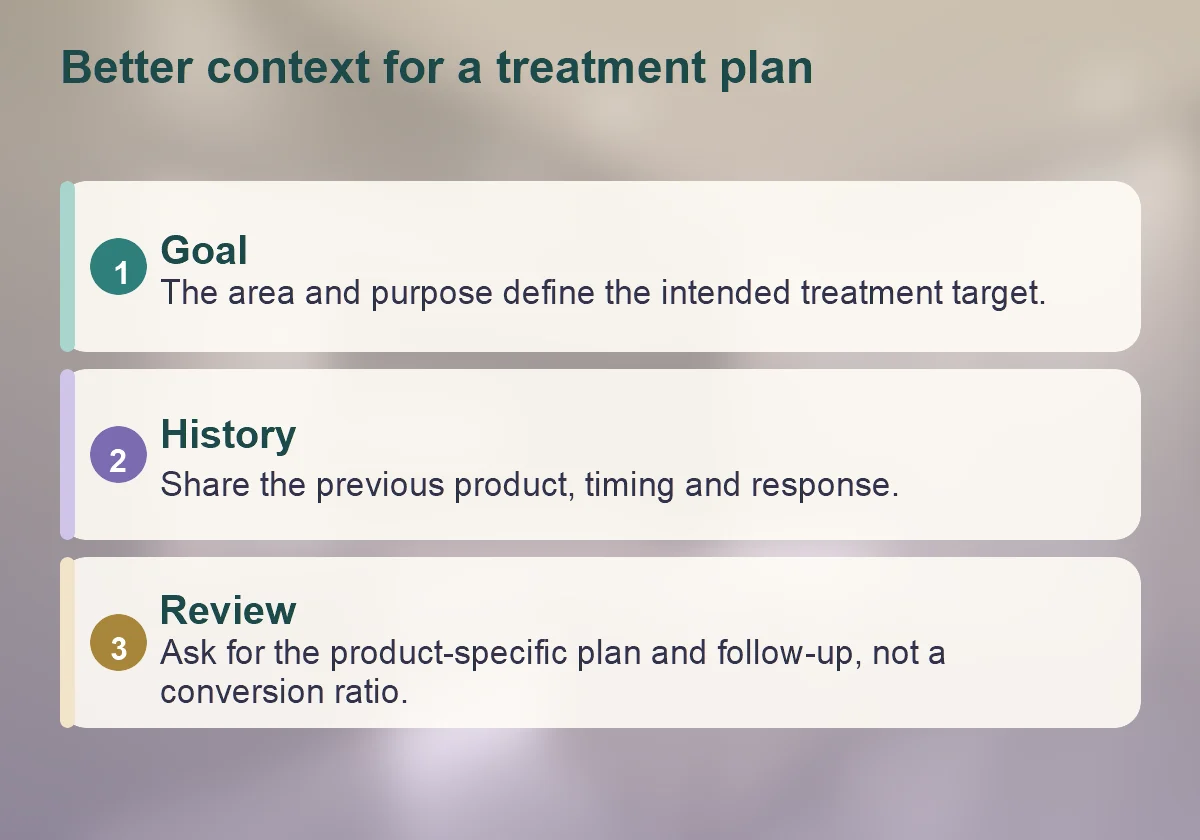
The treatment area and purpose matter because they identify the intended target and outcome. Previous treatment matters because the clinician needs to understand which product was used, when it was given and how you responded before considering another treatment. These are clinical questions, not details that can be replaced by selecting the largest number on a menu.
Bring previous records if available, and share current medicines, neuromuscular conditions and allergies. These can affect safety assessment and interactions. Ask the clinician to explain the named product, treatment goal and follow-up plan. Do not arrange additional botulinum toxin treatment independently because an earlier number seems low. If breathing or swallowing becomes difficult after treatment, seek emergency medical help immediately rather than waiting for a routine review.
Frequently asked questions
Can I carry my previous unit count to a new brand?
Not as an equivalent dose. Bring the record so the clinician can review the product, timing and response and make a new product-specific decision.
Does a larger liquid volume mean more Units?
Volume alone cannot answer that. Product identity and concentration matter, and neither a fuller syringe nor a larger volume establishes a better result.
Do the US labels confirm approval in Korea or Thailand?
No. They support the general warning about product-specific units, not a determination of local approval for a product or treatment area.
Sources: DailyMed: XEOMIN US prescribing information; DailyMed: BOTOX US prescribing information.
Questions before your visit?
For treatment enquiries and appointment requests, message us on WhatsApp with the treatment you are considering and your preferred visit date.
Individual results may vary.
Back to Blog →