Can Every Dermal Filler Be Dissolved?
No. Hyaluronidase can be considered for HA filler, but other materials need different assessment. Dissolving is not a risk-free reset or a guarantee of full recovery.
Published by Beauty Blossom

No, not every dermal filler can be dissolved. Hyaluronidase is an enzyme used to break down hyaluronic acid, or HA, filler, but that approach does not transfer to every other injectable material. Non-HA and permanent fillers have different removal limitations. Even with HA, reducing the material is not a guarantee of restoring the face exactly as it was or undoing every complication. The material, the reason for removal and the risks all need medical assessment.
Why does the material change the answer?
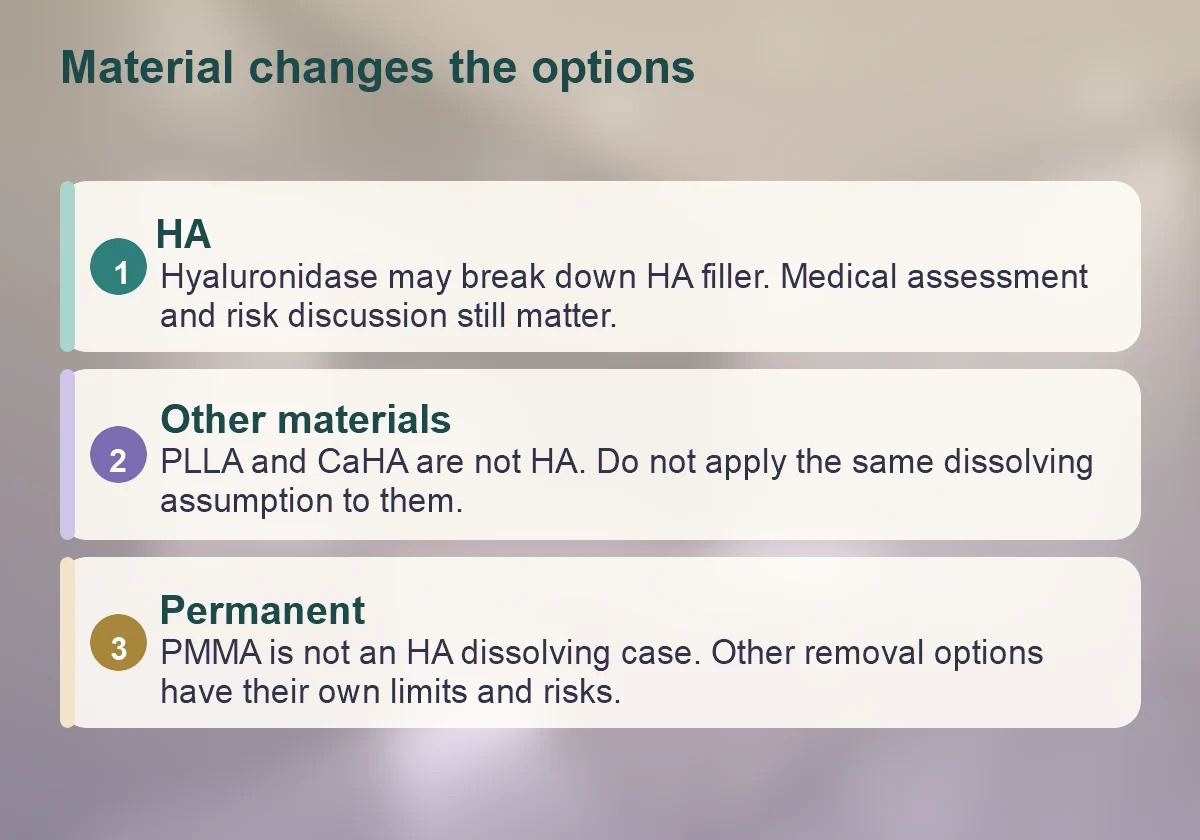
“Filler” describes a group of products, not one substance. HA is different from materials such as poly-L-lactic acid, abbreviated PLLA, calcium hydroxylapatite, or CaHA, and polymethylmethacrylate, or PMMA. The distinction matters because a method that breaks down HA is not a universal solvent for these other materials.
| Material | What to understand about removal |
|---|---|
| HA | Hyaluronidase may be considered; suitability, response and risks still need assessment. |
| Non-HA materials such as PLLA or CaHA | Do not assume the same enzyme reverses them. Other management may be needed. |
| Permanent material such as PMMA | Not equivalent to dissolving HA; removal may involve surgery and has limitations. |
Non-HA does not automatically mean permanent. FDA educational material distinguishes absorbable synthetic materials from non-absorbable PMMA. What matters is identifying the actual substance rather than deciding from the broad word “filler” or assuming every material behaves like HA.
What can hyaluronidase do, and what can it not promise?
Hyaluronidase can break down HA filler. That material-specific action explains why it is discussed as a removal option for HA, not as a reset button for all fillers. The FDA's 2025 review described HA removal with hyaluronidase as a clinically accepted off-label use in the United States. In the same document, it stated that no specific reversal agents existed for materials including PLLA, CaHA and permanent fillers such as PMMA.
Those are dated US statements, not a claim about today's regulatory status in every country. They do not establish approval in Korea or Thailand. More importantly for a treatment decision, being able to reduce HA material does not guarantee complete removal, an identical previous appearance or recovery from every filler-related problem.
Why is removal itself a medical decision?
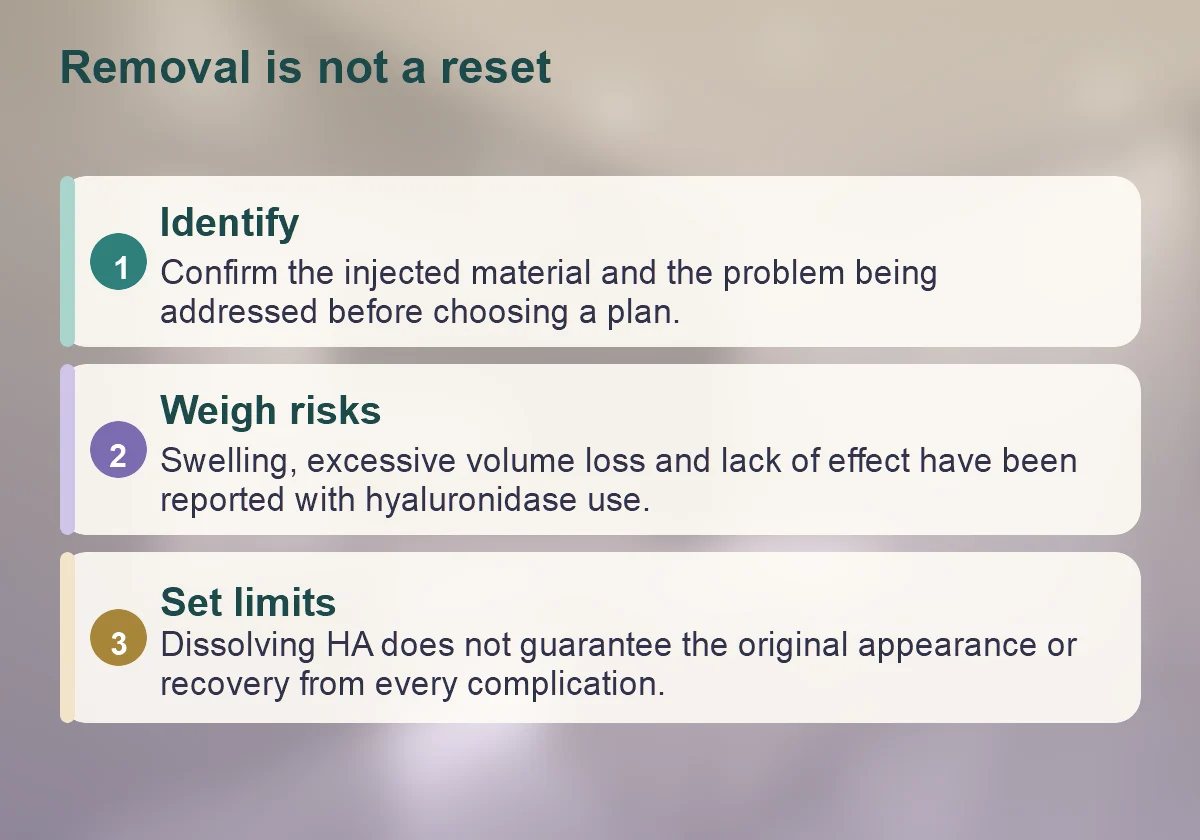
The 2025 FDA document described adverse-event reports associated with hyaluronidase use for filler, including swelling, burning, redness, excessive volume loss and lack of effect. These reports do not establish causation or an individual probability of harm. They are concerns to consider when weighing removal, not a measure of how often harm occurs.
For some non-HA or permanent materials, management can involve options other than an enzyme, including surgical removal. Surgery is a different intervention with its own assessment and limits, not a promise that the material can always be taken out completely. A clinician needs to consider the injected material and the problem being addressed before discussing what removal might achieve.
What should be clarified before agreeing to a plan?
Discuss removal limits before receiving filler, not only after becoming unhappy with a result. If filler is already present, share what you know about previous injections and implants, and tell the clinician about allergies and other medical conditions.
- What material is present, and what evidence identifies it?
- Is the aim to reduce unwanted volume or address a medical problem?
- Which removal options apply to this material, and what might remain unresolved?
- What are the risks, alternatives and limits of the proposed plan?
Do not try to dissolve filler at home or buy and inject a removal medicine yourself. An online explanation cannot select a drug, dose or removal technique for your tissues. If the material is uncertain, that uncertainty belongs in the clinical assessment rather than being filled in with a guess.
Frequently asked questions
Does temporary mean easy to reverse?
No. Temporary and permanent describe a different issue from whether an enzyme can break a material down. Not every non-permanent filler is HA.
Will dissolving HA restore my exact original face?
That cannot be guaranteed. Reducing HA material and restoring every aspect of appearance or function are different outcomes.
Does a non-HA filler mean nothing can be done?
Not necessarily. Other management may be considered, but it depends on the material and problem. It should not be presented as the same dissolving treatment used for HA.
Medical note: This is general information, not an individual removal plan or a guarantee of recovery. Product suitability, available treatments and local authorisation require appropriate clinical review.
Sources
- FDA dermal filler panel executive summary, 2025, pages 16–17
- FDA Clinical Overview of Dermal Fillers, 2021, pages 7–8
- AAD: Fillers preparation and consultation questions
Questions before your visit?
For treatment enquiries and appointment requests, message us on WhatsApp with the treatment you are considering and your preferred visit date.
Individual results may vary.
Back to Blog →