Why Picking and Harsh Scrubbing Can Prolong Dark Marks After Acne
Picking can add inflammation, while harsh cleansing can irritate healing skin. Learn why reducing repeat injury matters for post-acne dark marks and what to change in your routine.
Published by Beauty Blossom
Picking a healing spot or scrubbing a dark mark can work against the result you want. Acne inflammation can trigger extra melanin, the pigment that gives skin its colour. Picking adds injury and can prolong healing; rough cleansing can add irritation. These are reasons a dark mark may become more noticeable or keep being renewed, rather than a way to remove it. Not every touch causes pigmentation, but repeatedly injuring irritated skin is an avoidable risk.
Why a healed spot can still look dark
When inflammation settles, the skin surface may become flat while a brown or darker patch remains. This can be post-inflammatory hyperpigmentation, often shortened to PIH. Acne, an injury and irritating skin-care products can all be triggers. The link is particularly important in medium to darker skin tones, where a new episode of irritation can leave another dark area.
A flat colour change is usually different from a structural scar. A depression or raised area involves a change in the skin’s contour, not just pigment. Redness alone does not establish PIH, and neither colour nor the word “mark” is enough to diagnose the cause.
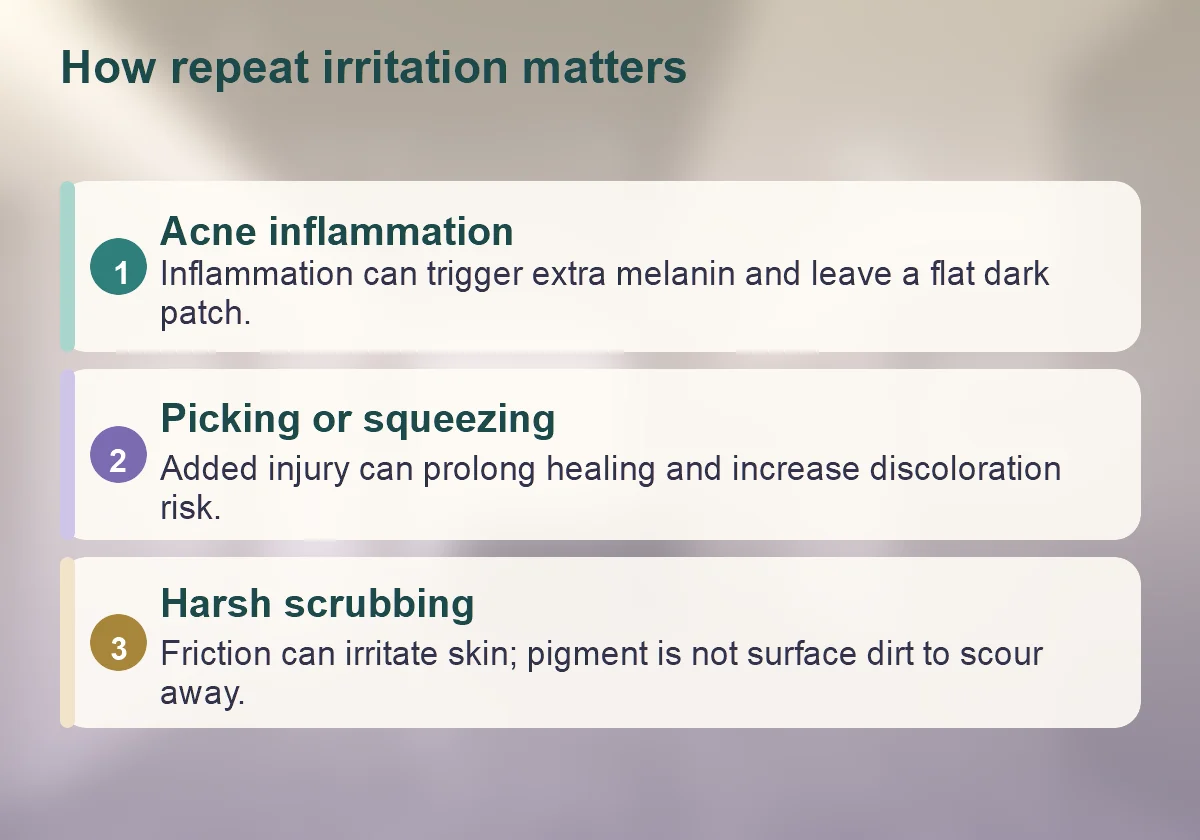
Picking and scrubbing add different problems
| Habit | Why it can be unhelpful | Useful alternative |
|---|---|---|
| Picking or squeezing | Can increase inflammation, delay healing and raise the risk of discoloration and scarring. | Leave the spot alone and address ongoing acne. |
| Rough cloths, brushes or scrubs | Can irritate skin rather than wash away pigment. | Use a gentle, non-abrasive cleanser with your fingertips. |
| Adding more products when skin stings | Product irritation can become another pigment trigger. | Review irritating non-prescription products and discuss reactions to prescribed care with the prescriber. |
Dark pigment is not surface dirt. Rubbing harder does not solve the inflammatory trigger. Picking also creates a new injury at a site already recovering from acne. The practical goal is to reduce repeated inflammation, not to make the skin feel stripped or polished.
Choose care that does not restart the cycle
Cleanse gently rather than trying to scour a spot clean. Avoid repeatedly testing the area by scraping or squeezing it. Choose products labelled non-comedogenic, meaning they are formulated not to clog pores. If a non-prescription product repeatedly burns or stings, do not keep adding stronger products to overcome the reaction. Ask about a gentler alternative. For a prescribed acne medicine, contact the prescriber about irritation instead of changing or stopping treatment on your own.
Sun protection belongs in pigment care too. A broad-spectrum, non-comedogenic sunscreen helps protect acne-prone skin. A tinted sunscreen containing iron oxides can also be considered for dark-spot care. Choose a tolerable routine you can use consistently; sunscreen is not a replacement for avoiding picking or managing acne.
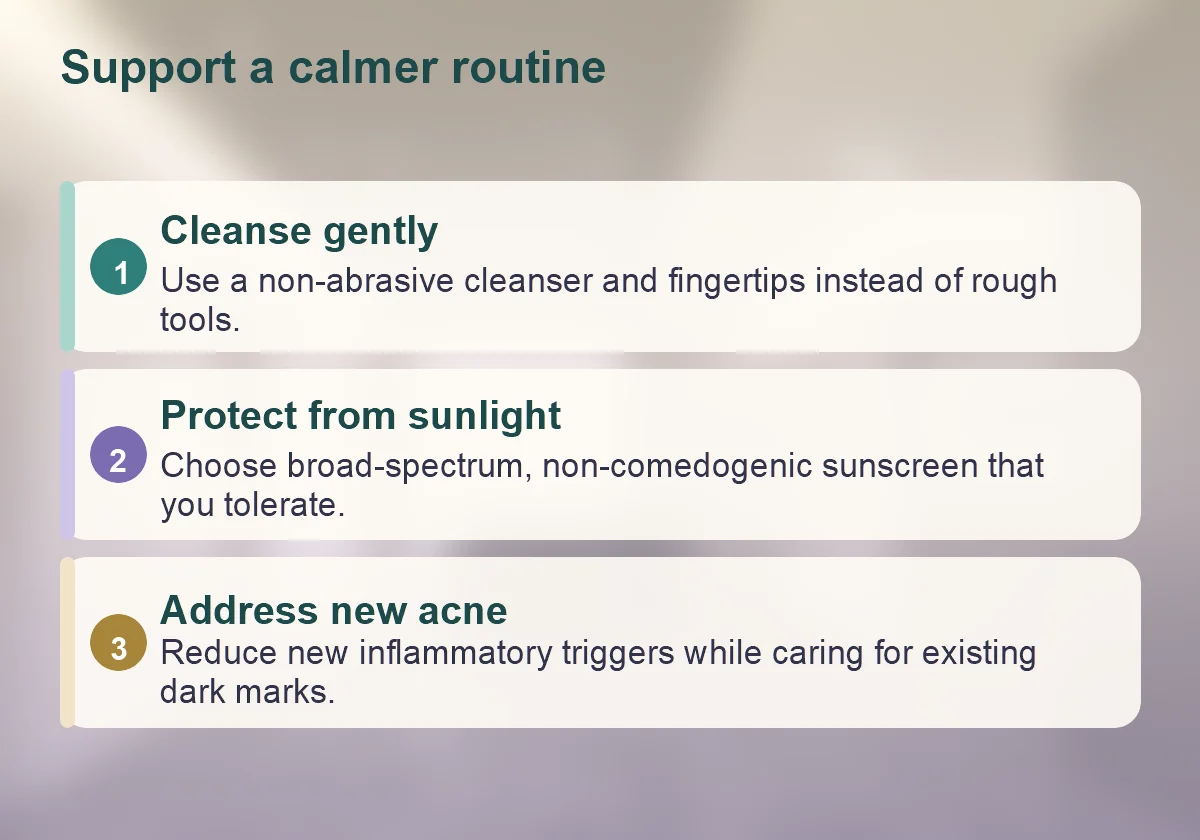
Manage new acne as well as old colour
If new inflamed spots keep appearing, they can keep creating new marks even while older ones lighten. Acne control and protection from irritation therefore support the same goal. Focusing only on a fading product misses the source of repeated inflammation.
Some flat marks become lighter over time, but there is no single clearing date for everyone. Seek medical assessment for deep, painful or recurrent acne, new indentations or raised areas, or uncertainty about what a persistent patch represents. The useful distinction is whether the target is ongoing acne, colour change or a change in skin structure. A product aimed at colour should not be expected to fill a depression.
Frequently asked questions
Can exfoliating harder remove a dark acne mark faster?
No. A dark mark is not simply dirt or loose skin to scrub off. Harsh friction can irritate the skin and become another trigger for pigment change.
Is every flat red patch after acne PIH?
No. Redness does not by itself identify excess melanin. Persistent or unclear colour changes need assessment rather than a diagnosis based only on colour.
Should I focus on old marks or new breakouts?
Both matter. Reducing new acne helps reduce new inflammatory triggers, while gentle care and sun protection avoid adding preventable irritation to existing marks.
Sources
- AAD: How to fade dark spots in darker skin tones
- AAD: 6 skin care habits that can clear acne
- AAD: Acne scars overview
Questions before your visit?
For treatment enquiries and appointment requests, message us on WhatsApp with the treatment you are considering and your preferred visit date.
Individual results may vary.
Back to Blog →