Is IPL the Same as a Laser? Light Sources, Filters and Targets Explained
IPL and lasers can both act on light-absorbing targets in the skin, but they produce light differently. Understand what wavelengths and filters mean without turning the distinction into a claim that one treatment is always better.
Published by Beauty Blossom
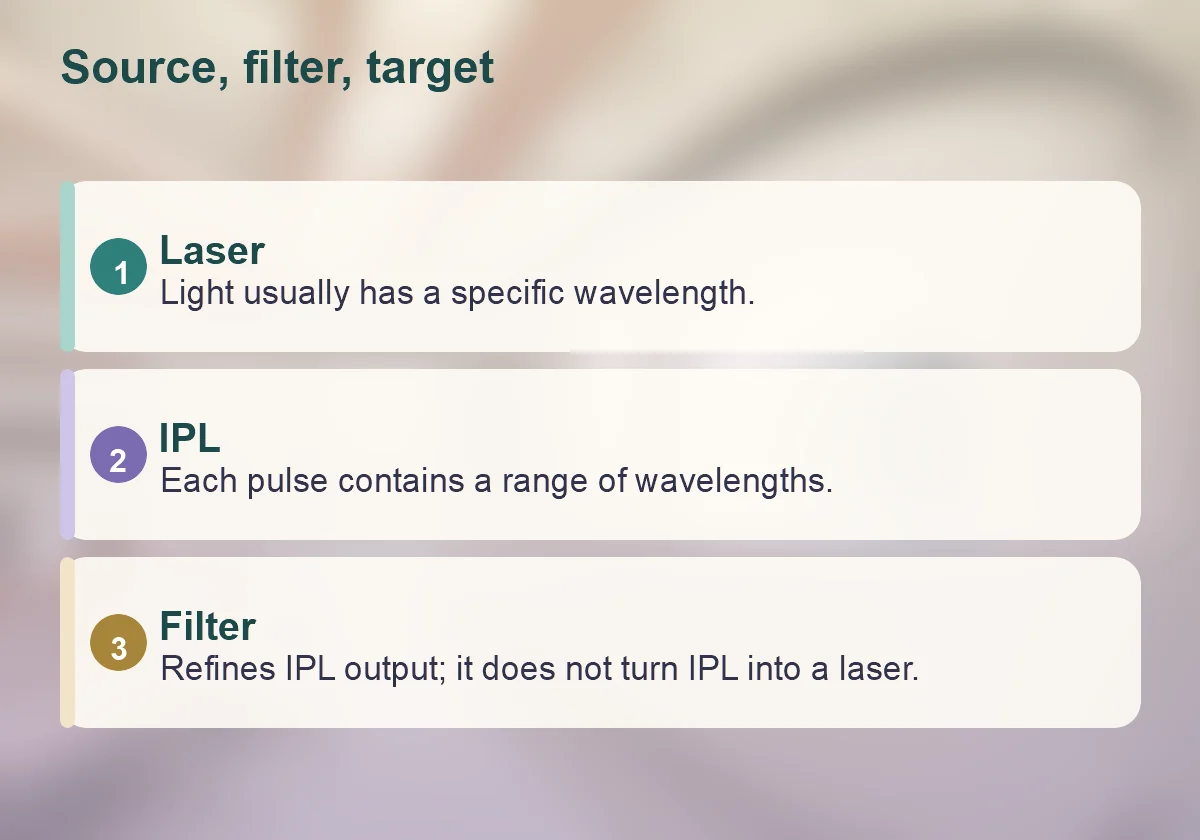
No. Intense pulsed light, or IPL, is not a laser. IPL delivers pulses containing a broad range of wavelengths, while laser light usually has a specific wavelength. Both can use light absorbed by a target in the skin, but sharing that principle does not make them the same technology. Nor does the distinction, by itself, tell you which treatment would suit a particular concern.
One wavelength or a range of wavelengths
A wavelength describes a colour of light. Laser light usually consists of one specific wavelength; IPL contains many wavelengths in each pulse. Think of this as a difference in the light being produced, rather than a score for treatment quality.
The words also answer a different question from the treatment's purpose. Hair reduction, a visible blood vessel and a pigmented spot are not interchangeable targets simply because light-based devices may be used for them. Start by separating the light source from the problem it is intended to address.
What an IPL filter does
Most IPL systems use filters to refine the light delivered for a particular treatment. A filter limits the output so that it can be directed towards the intended light-absorbing target. It does not turn the IPL source into a laser.
This is why the word IPL alone is not a complete treatment description. The intended target and the filtered light both matter. Equally, saying only laser leaves out the particular wavelength and purpose. Asking what the light is intended to act on is more useful than assuming that either label describes a single, universal procedure.
Different targets can absorb the light
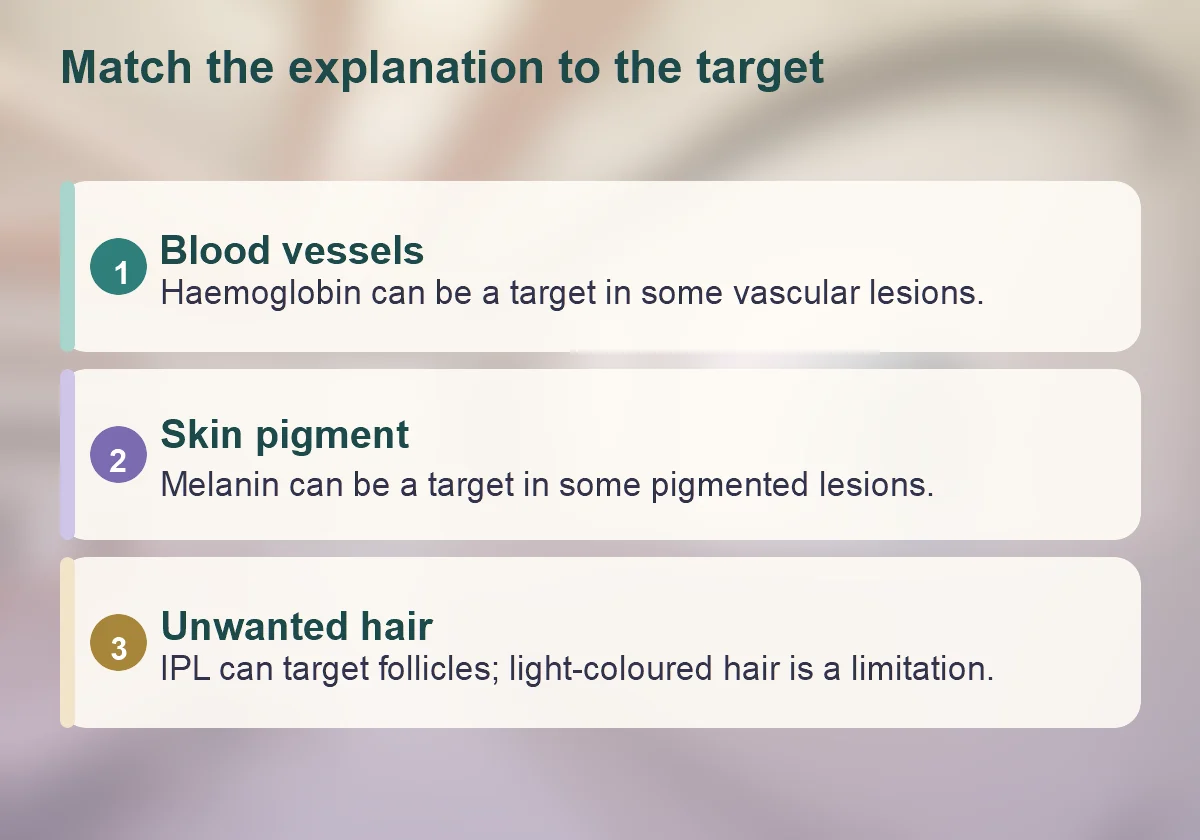
A chromophore is a substance that absorbs light. In the heat-based mechanism described for IPL, absorbed light becomes heat and acts on the target. The following examples explain different uses; they are not a list of treatments that every clinic offers.
| Concern | Target in the IPL explanation | Important distinction |
|---|---|---|
| Some visible vascular lesions | Haemoglobin in blood | Not every form of redness has the same cause. |
| Some pigmented lesions | Melanin in the skin | The lesion still needs an appropriate diagnosis. |
| Unwanted hair | The hair follicle | Light-coloured hair is generally a limitation for IPL. |
These examples show why a shared light source does not make all treatment goals equivalent. A description of treating pigment is not automatically an explanation of treating hair, even when both mention colour and light absorption.
What the technology name cannot decide
IPL is not risk-free because it is not a laser. Skin pigment can absorb too much light energy, and blistering can occur. Correct diagnosis and an assessment of realistic expectations remain important before treatment.
Rather than asking for a winner between the two labels, ask questions that connect the technology to the actual concern:
- What has been identified as the target: pigment, a blood vessel or a hair follicle?
- Which light source is proposed, and what is its intended role?
- What limitations apply to this concern and the skin being treated?
The useful distinction is therefore source, target and purpose, not simply IPL versus laser as competing badges. A clear explanation should connect those points without promising that one name guarantees a result.
Frequently asked questions
Does using a filter make IPL a laser?
No. Filtering refines the output of a broad-spectrum light source. It does not change IPL into laser light.
Can IPL be used for hair removal as well as skin concerns?
Yes, hair removal is one general use of IPL. That does not establish whether a particular clinic offers it or whether it suits an individual.
Does a specific laser wavelength mean it is always better?
No. A wavelength describes the light, not a universal treatment ranking. The diagnosis, intended target and limitations still need to be considered.
Sources
Questions before your visit?
For treatment enquiries and appointment requests, message us on WhatsApp with the treatment you are considering and your preferred visit date.
Individual results may vary.
Back to Blog →