What Determines Chemical Peel Depth Besides Acid Percentage?
Acid percentage is only one variable. Ingredient type, formulation, pH, exposure and skin characteristics all matter when describing chemical peel depth.
Published by Beauty Blossom

Chemical peel depth depends on more than the acid percentage: the ingredient, formulation and pH, contact time, amount applied and skin characteristics all matter. Light, medium and deep describe how far a peel acts within the skin, not a universal ranking based on a number on a bottle. A percentage is useful information, but it cannot describe the whole treatment or predict an individual's response.
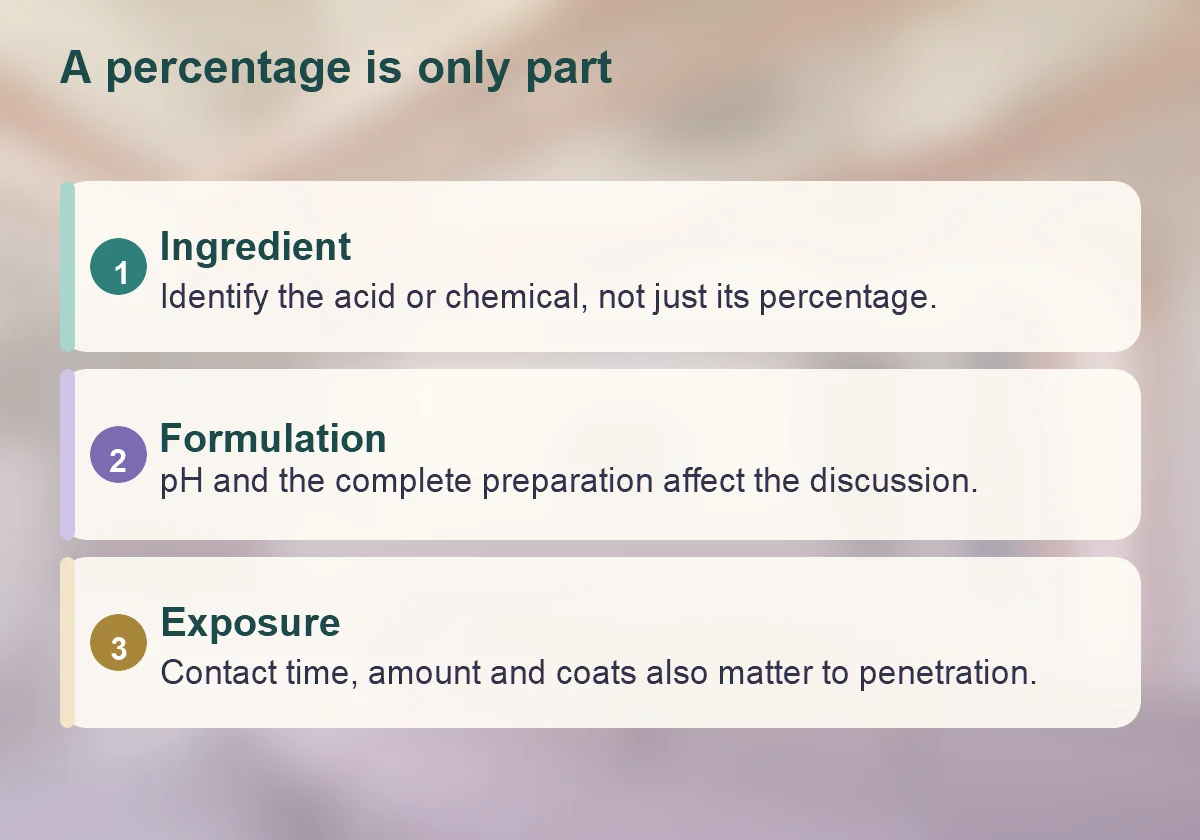
Start with the chemical, not just the percentage
A chemical peel uses a chemical substance to cause a controlled change in skin tissue. DermNet describes different families, including alpha-hydroxy acids, trichloroacetic acid and phenol-based peels. These are different substances, not interchangeable versions of one ingredient.
A percentage tells you about concentration within a formulation. It does not identify everything else in that formulation or how it will be applied. Comparing percentages across different acids therefore leaves out essential information. Even identifying the ingredient does not, by itself, establish the depth of a particular treatment.
Why formulation and pH change the picture
Formulation means the complete preparation, including how the active substance is presented. Mediderma's professional reference discusses gel and solution preparations separately. In its gel example, contact time matters to depth; in its solution example, the amount and number of coats matter. These examples show why the physical preparation cannot be ignored.
pH describes acidity or alkalinity. It is not another way of writing acid percentage. Mediderma also describes how the balance between acid and its salt relates to pH, with exfoliating activity changing as pH changes. That does not create a universal conversion between one product's percentage and another product's strength. Ingredient identity and the complete formulation still matter.
Exposure and skin are part of the treatment
The FDA identifies concentration, number of applications and the time a chemical peel stays on the skin as influences on penetration. Here, applications means applying the product during the procedure, not a recommendation for repeat clinic visits. These are variables for professional assessment, not instructions to add another coat or leave a product on longer.
| Variable | What it adds to the assessment |
|---|---|
| Contact time | How long the skin is exposed to the preparation |
| Amount and coats | How much product is applied during the procedure |
| Skin characteristics | Thickness, sensitivity and skin type |
| Preparation and observation | The condition of the skin before and during application |
Mediderma includes thickness and hypersensitivity among relevant skin characteristics. The AAD describes individual pre-peel preparation and careful observation during application. Skin is not a uniform surface, so a label cannot substitute for assessing the person receiving the peel.
Light, medium and deep describe tissue depth
| Category | General tissue description |
|---|---|
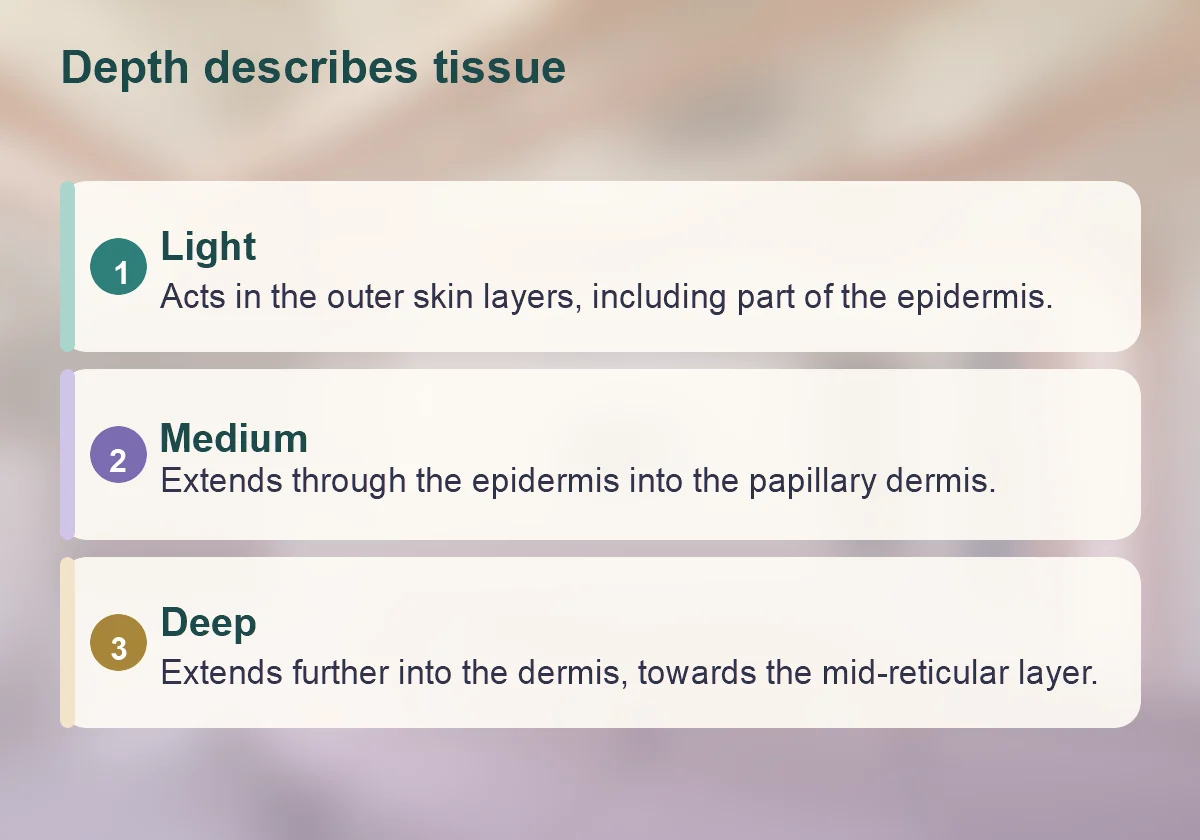
| Light or superficial | The outer skin layers, including part of the epidermis |
| Medium | The epidermis and part or all of the papillary dermis beneath it |
| Deep | Further into the dermis, reaching the mid-reticular dermis |
These categories describe anatomical extent. They are not a recipe assigning every acid percentage or branded facial to a fixed depth, and deeper does not automatically mean more appropriate. Ask which preparation is proposed, what depth is intended and which skin factors informed that choice.
The FDA warns that chemical peel products can cause serious skin injuries without appropriate professional supervision. Do not turn the variables above into a home experiment with concentration, pH, exposure or repeated application.
Frequently asked questions
Can two peels with the same percentage act differently?
Yes. Ingredient identity, pH, formulation, application and skin characteristics provide information that the percentage alone does not capture.
Is pH the same thing as acid concentration?
No. Concentration describes the amount of an ingredient in a preparation; pH describes its acidity or alkalinity. Both belong in the formulation discussion.
Can a treatment name tell me its depth?
Not on its own. Depth depends on the actual preparation, application and skin assessment, not simply a menu name or the word peel.
Sources
- FDA: professional-supervision warning
- Mediderma: professional reference, peel principles
- DermNet: chemical peels
- AAD: chemical peel FAQs
Questions before your visit?
For treatment enquiries and appointment requests, message us on WhatsApp with the treatment you are considering and your preferred visit date.
Individual results may vary.
Back to Blog →