Facial Redness Is Not One Laser Target
Flushing, persistent redness, visible vessels and irritation are different patterns. See what AAD rosacea guidance says about triggers and where a vascular laser fits.
Published by Beauty Blossom
Facial redness is not one finding. Flushing that comes and goes, redness that stays, small visible blood vessels and irritated skin can look alike in a mirror, yet they are different patterns. Lasers are most often considered for visible blood vessels, so a vascular laser should not be expected to answer every cause of redness. Sorting the pattern comes before choosing a treatment.
Four patterns, four different questions
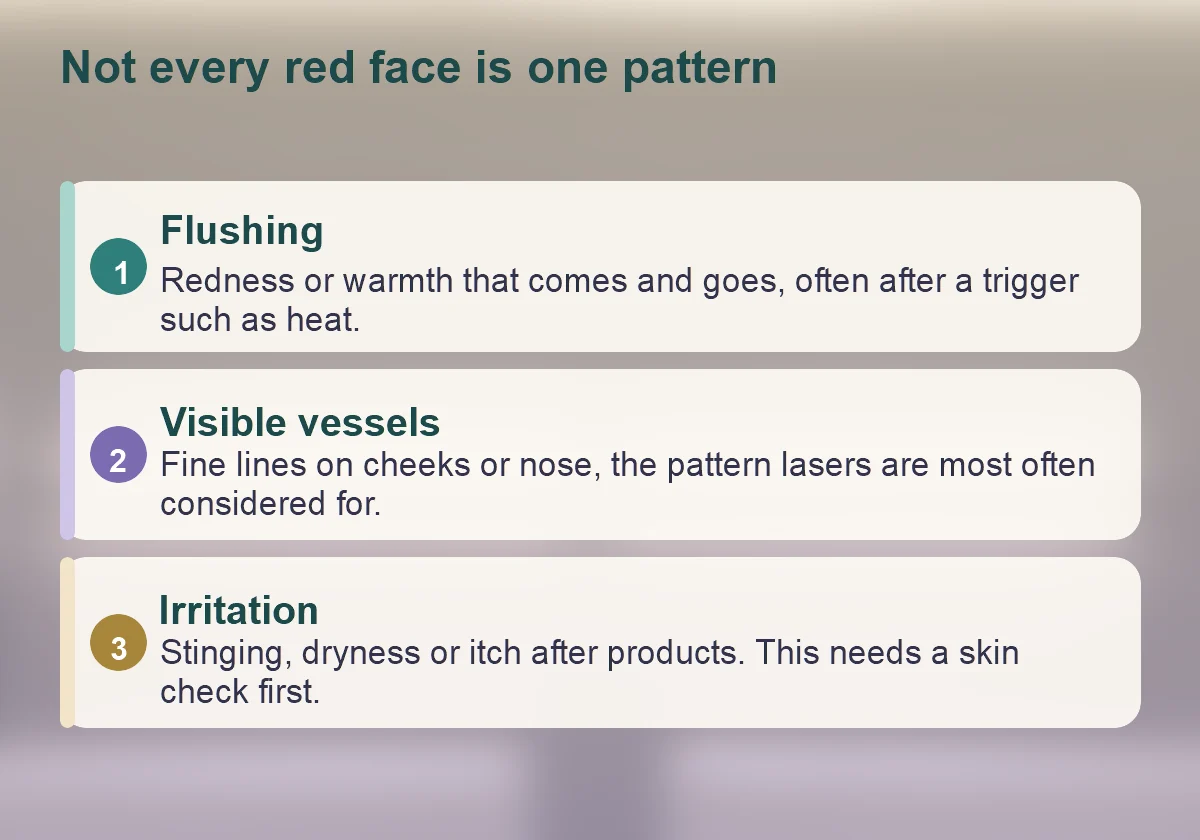
| Pattern | What it can look or feel like | Question to ask |
|---|---|---|
| Flushing | Redness and warmth that come and go; on darker skin it may show mainly as warmth | What happened just before it started? |
| Persistent redness | Colour that stays across the nose and cheeks for weeks or longer; it may look red, violet or brown | Has it become constant? |
| Visible vessels | Fine lines on the cheeks or nose, easier to see on lighter skin | Can individual vessels be seen? |
| Irritation | Burning, stinging, dryness or itch when products touch the skin | What changed in my routine? |
These patterns can overlap. A person may flush easily and also have fine vessels, and irritation can sit on top of either one. That is why starting with "which laser?" skips an earlier question: "which pattern am I actually looking at?" Answering it helps you describe your skin clearly and helps the clinician decide what needs examining first, whether that is the vessels, the skin barrier or something else.
Where rosacea fits, and where it does not
The American Academy of Dermatology (AAD) describes rosacea as commonly involving flushing, longer-lasting colour change, acne-like bumps, visible blood vessels, and burning or stinging, and notes that people often have more than one sign. That does not mean every red face is rosacea. Irritation and other conditions can overlap, and only an examination can tell them apart. If redness comes with gritty, dry, itchy or light-sensitive eyes, mention it, because the AAD says rosacea can affect the eyes.
Triggers worth noting
The AAD lists sun, heat, hot drinks, alcohol, spicy food, stress and skin or hair products that burn or sting as triggers for some people with rosacea. Triggers differ from person to person, so treat this as a list of things to notice, not a diagnosis. Write down when flushing happens and what came before it. A short record gives a clinician more to work with than "my face is red".
What a vascular laser can and cannot cover
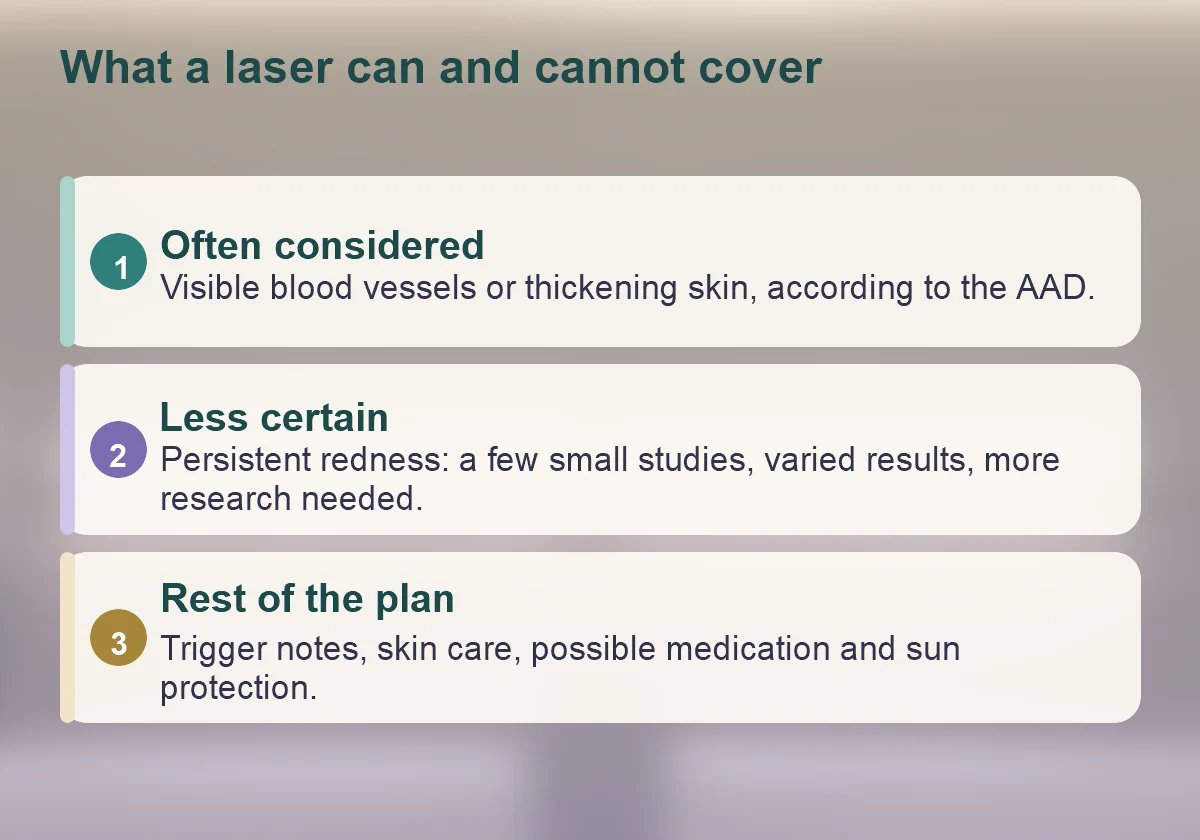
The AAD says laser or light therapy may be part of a rosacea plan but is unlikely to be the only treatment. A plan often also includes medication, a rosacea-friendly skin care routine and ways to avoid flare-ups. A laser is most likely to be considered when visible blood vessels or thickening skin are present. For persistent redness, the AAD says a few small studies used lasers, results varied, and more research is needed.
New visible vessels can form after treatment. Temporary redness is common afterwards, and some people get red or purple spots. The AAD stresses sun protection afterwards to help prevent lasting marks. Beauty Blossom's menu lists a V Laser, but whether any laser suits your redness depends on an examination.
Before you book: a short checklist
- Note when flushing happens and what came before it
- List products that sting or leave skin dry
- Mention warfarin, isotretinoin, aspirin, cold sores, light sensitivity and easy bruising, which the AAD lists as useful for your dermatologist to know
- Ask which pattern the clinician sees: flushing, persistent redness, vessels or irritation
- Ask what else, besides a laser, belongs in the plan
FAQ
Can a laser treat all redness? No. Evidence is stronger for visible blood vessels than for general redness, and irritation needs a skin check rather than a laser.
Do visible vessels mean I have rosacea? Not by themselves. The AAD lists them as one sign among several, and a diagnosis comes from an examination.
My face stings with most products. Does that matter before a laser? Yes. Tell the clinician, because stinging, dryness and itch can point to irritated skin that should be assessed first.
Sources
- American Academy of Dermatology: Rosacea signs and symptoms
- American Academy of Dermatology: Rosacea treatment with lasers and lights
- American Academy of Dermatology: How to prevent rosacea flare-ups
Clinic information and contact
For treatment details or appointment enquiries, use the clinic's official channels.
Location
Beauty Blossom Clinic
66 Yanghwa-ro, Mapo-gu, Seoul, Republic of Korea (6th and 8th floors)
Individual results may vary.
Back to Blog →