Why Does Laser Hair Removal Need Repeat Sessions, and Is Visible Hair New Growth?
Hair follicles do not grow in step. Learn why repeat sessions are considered, how shedding differs from later regrowth, and why visible hair alone cannot tell you whether treatment worked.
Published by Beauty Blossom
Laser hair removal needs repeat sessions because hairs are not all in the same growth phase at the same time. Treatment acts on actively growing hair, so one visit cannot address every follicle under the same conditions. Hair still visible afterwards is not automatically new growth: treated hairs may remain temporarily before shedding.
One visit meets different growth stages
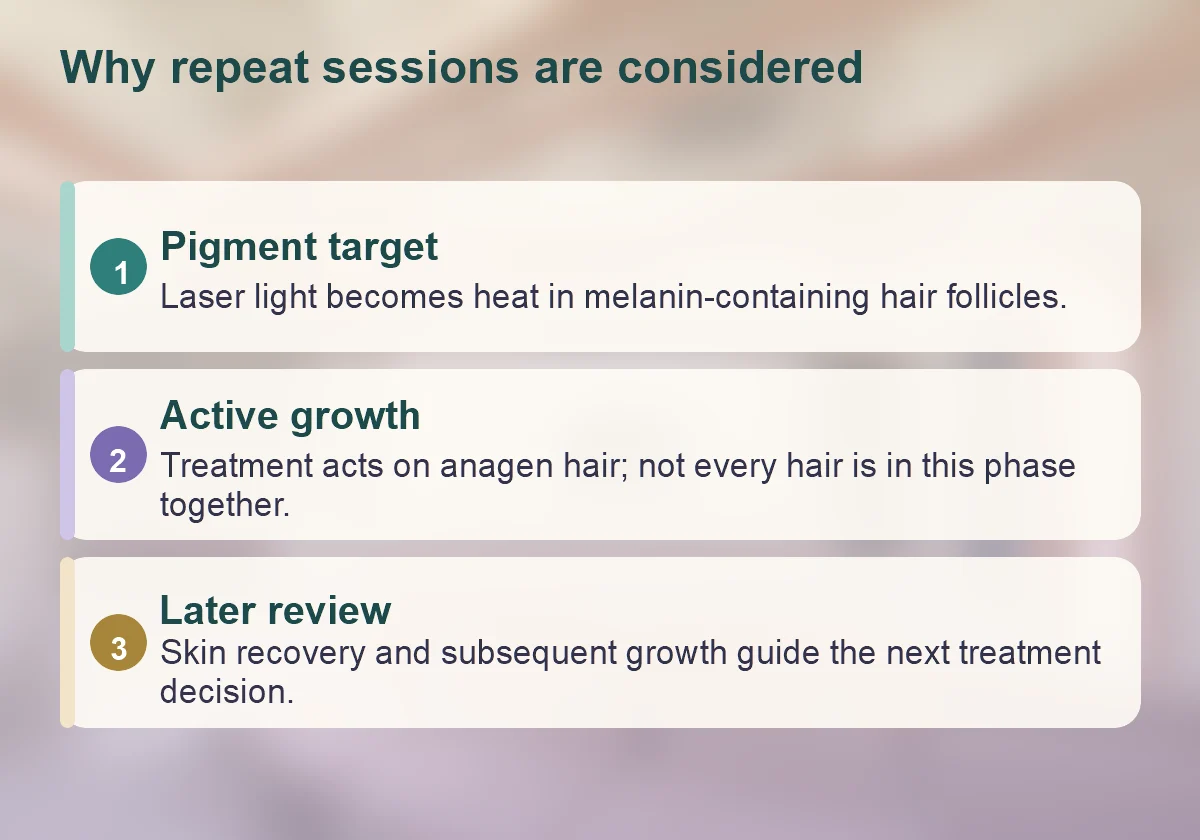
Laser light is absorbed by melanin, the pigment in the hair follicle, and converted to heat that damages the hair and the base of the follicle. Anagen is the active growth phase on which laser treatment acts. Even within one treatment area, hairs are not all in anagen together.
This is why repeat treatment is considered. It is not simply a matter of repeating the same visit until the skin looks completely bare. A later assessment considers growth that was not in the same responsive stage earlier, alongside how the skin recovered. The number of visits cannot be read from a single photograph or another person's treatment plan.
Shedding is not the same as regrowth
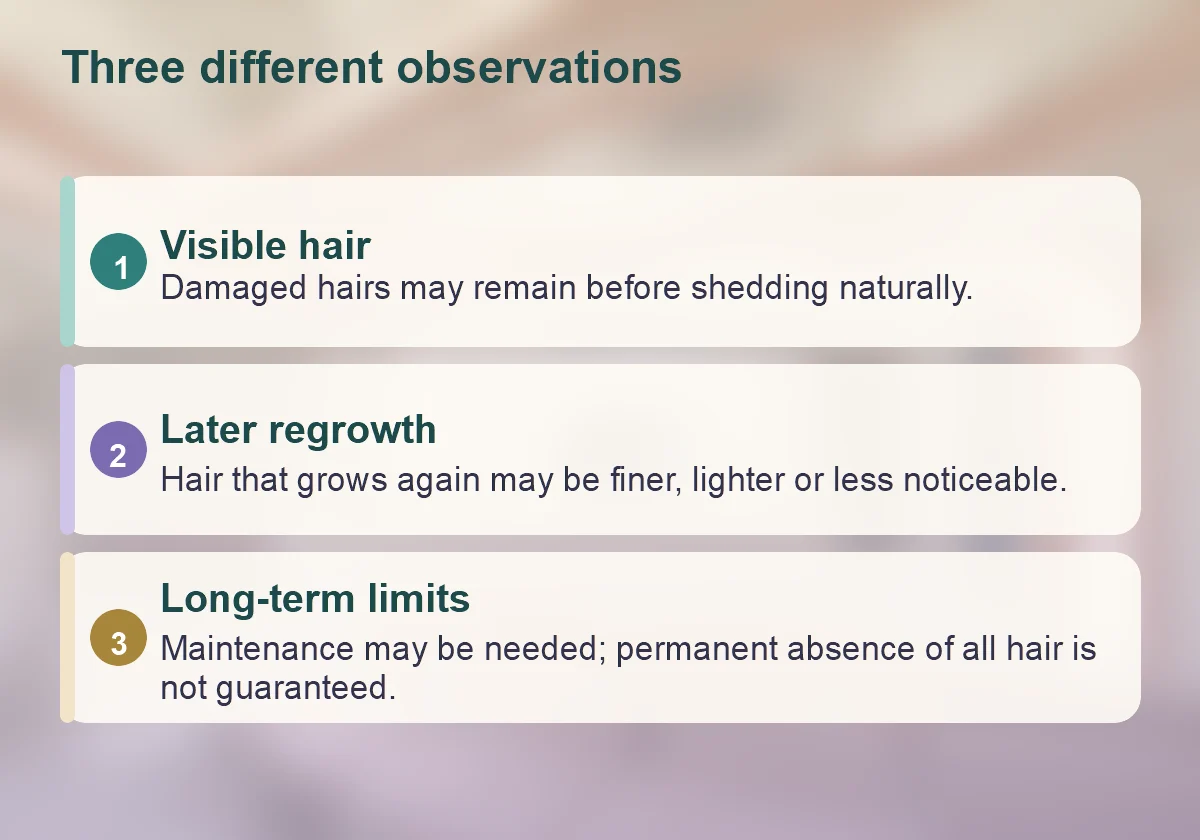
Damaged hairs do not necessarily disappear at the appointment. They can shed naturally afterwards. Later regrowth is a different observation: hair grows again after treatment and may look finer, lighter or less noticeable. A glance at visible hair cannot reliably establish which process is happening.
| Observation | What it can mean | What it does not prove |
|---|---|---|
| Hair remains visible after treatment | Treated hair may still be awaiting natural shedding | Immediate failure or definite new growth |
| Hair grows again later | Regrowth may be finer or lighter | That every follicle has returned to its original state |
| Less noticeable growth over time | A change in the amount or appearance of hair | Permanent freedom from all future hair |
When discussing progress, distinguish hair that remained visible from hair noticed growing later. Describe the sequence and the skin's response rather than treating every visible hair as the same event.
Reduction is a different goal from lifelong absence
Complete removal and permanent absence of regrowth cannot be guaranteed. Some people may need maintenance treatment. Finer or lighter regrowth can be a meaningful change, but it is not the same as a promise that no hair will ever return.
Growth phase is also not the only influence on results. Hair colour and thickness, the treated area, the type of laser and skin colour matter. The cycle explains why repeat sessions can be necessary; it does not explain every difference in response or provide a universal treatment count.
The next visit depends on skin and growth
The clinician should assess the skin's recovery and subsequent growth before deciding when another treatment is appropriate. A fixed calendar rule cannot replace that assessment. Bring a clear account of what shed, what later grew and whether the skin changed.
Burns, blisters, scarring and changes in skin colour are possible; some pigment changes can persist. Report concerning skin changes rather than treating them as evidence that a stronger treatment is working. Share tanning, medicines and previous reactions, and ask for sun-protection advice relevant to your skin. These details help separate a question about hair progress from a question about skin safety.
Common questions
Does visible hair immediately after treatment mean it failed?
No. Damaged hairs may remain before naturally shedding. Appearance alone does not distinguish shedding from new growth.
Does finer regrowth mean I will soon have no hair permanently?
No. Regrowth can be finer, lighter or less noticeable, but complete and permanently hair-free results are not guaranteed. Maintenance may be needed.
Should everyone book the next visit at the same interval?
No. The timing should reflect individual skin recovery and growth, assessed by the treating clinician.
Sources: Leeds Teaching Hospitals: Laser Hair Reduction; American Academy of Dermatology: Laser hair removal FAQs.
Questions before your visit?
For treatment enquiries and appointment requests, message us on WhatsApp with the treatment you are considering and your preferred visit date.
Individual results may vary.
Back to Blog →