Why Does a Recent Tan Matter Before Laser Hair Removal if Your Natural Skin Colour Is the Same?
Natural skin colour and recent tanning are different pieces of information. Learn how epidermal melanin can absorb laser energy, why sunless tanners also need mentioning, and why the skin's current condition matters before treatment.
Published by Beauty Blossom

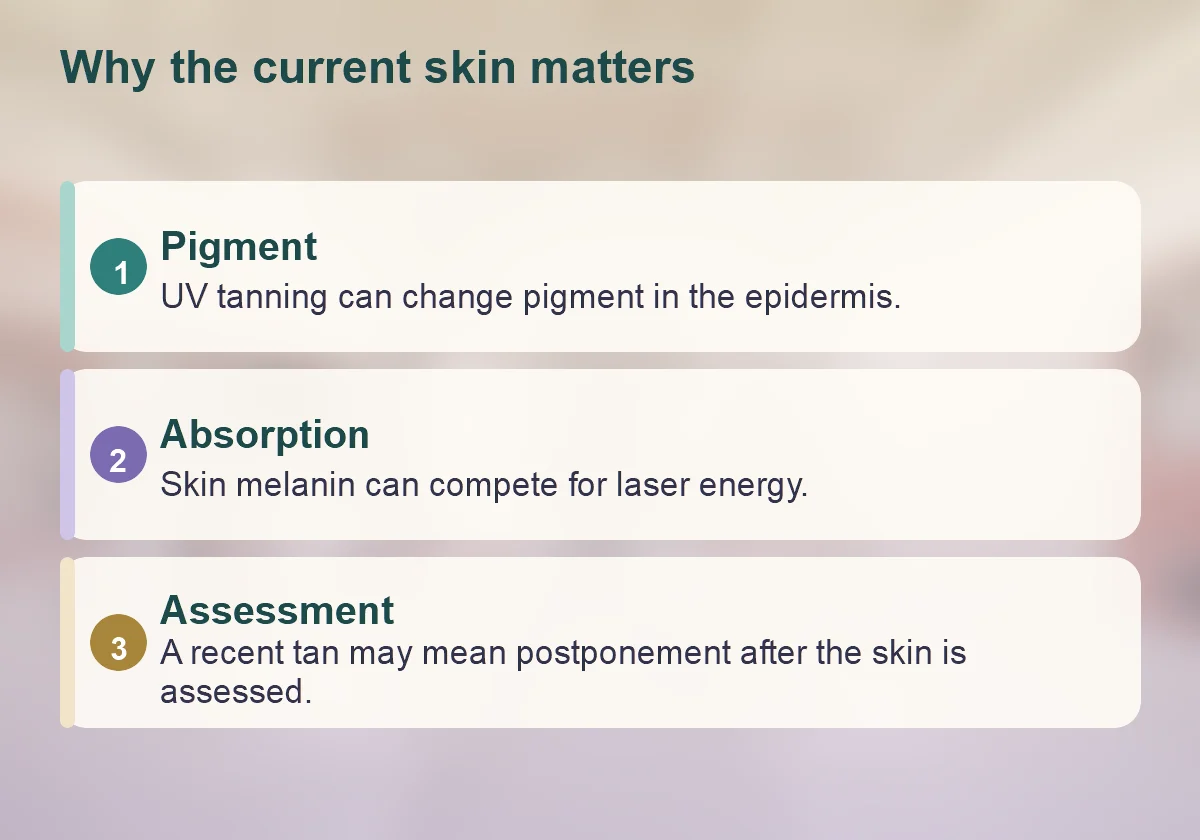
A recent tan matters because natural skin colour does not describe everything happening in the skin today. UV exposure can change pigment in the epidermis, the outer skin layer. That pigment can absorb laser energy as well as the intended target. Two people with the same natural skin colour, or the same person at different appointments, can therefore need different assessments after recent tanning.
Baseline colour and recent exposure are different
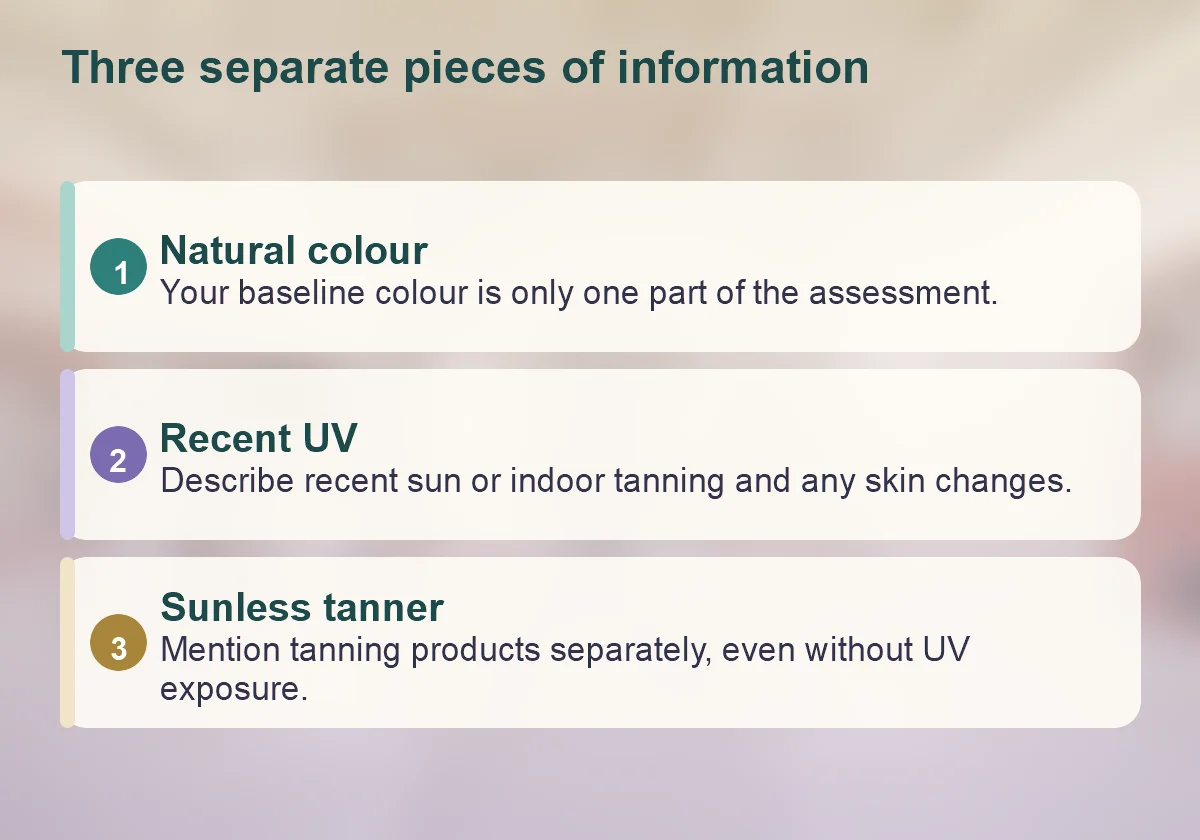
Your usual skin colour is one part of the assessment. Recent sun exposure, indoor tanning and any resulting redness or colour change are another. A previous appointment is not a substitute for describing what has happened since then.
UV responses include redness or sunburn, immediate pigmentation and delayed tanning. Delayed tanning involves melanin production and its distribution through the epidermis. Not every pigment response is identical: some immediate tanning involves changes to melanin already present. The important point is that recent exposure adds information beyond your usual colour.
Why pigment in the epidermis matters
Melanin is a light-absorbing pigment. In laser treatment, melanin in the skin can act as a competing absorber of energy. In other words, the intended treatment target is not the only place where light may be absorbed.
This competition helps explain concern about injury to the epidermis and associated side effects. North Bristol NHS Trust's hair-removal guidance identifies having a suntan as a circumstance associated with a higher risk of side effects. That is a reason to assess the current skin, not a reason to assume that naturally darker skin rules out laser treatment.
A useful way to frame the question is not simply, “What is my skin colour?” but, “Has recent exposure changed the condition of the area being treated?” The second question keeps the focus on today's skin rather than a colour description alone.
Keep these parts of the history separate
Sunless tanning products also belong in the discussion. They should not be treated as an unimportant detail just because their use is not UV exposure. Preparation guidance advises avoiding both tanning and sunless tanners, without making them the same biological process.
| Information | What to explain | Why it matters |
|---|---|---|
| Usual skin colour | Your baseline skin appearance | It does not replace a recent-exposure history. |
| Recent UV exposure | When and where exposure occurred, plus any redness or tan | Current pigment and skin reactions need assessment. |
| Sunless tanner | Whether a tanning product was used on the area | It is a separate preparation issue to disclose. |
Readiness needs a skin assessment, not a countdown
Tell the treating team about a recent tan before proceeding, even if your natural colour is unchanged. Explain the area exposed, the timing and any redness or sunburn. Mention sunless tanning products separately rather than describing all colour changes simply as a tan.
A tan can mean postponing laser hair removal. The decision should consider the skin's current condition and recovery, together with the exposure history. A fixed number of days on a calendar is not, by itself, an assessment that the skin is ready.
- Avoid outdoor and indoor tanning when preparing for treatment.
- Avoid sunless tanners and disclose recent use.
- Have the treatment area examined and follow the treating clinician's preparation instructions.
The aim is to give the clinician an accurate picture, not to decide at home that a familiar skin tone means familiar treatment conditions. Whether treatment can proceed needs to be settled for the current appointment.
Frequently asked questions
Does the same natural skin colour mean the same tanning risk?
No. Recent exposure and current skin changes are additional information. Baseline colour alone cannot replace that history and examination.
Should I mention self-tanner even without sun exposure?
Yes. Sunless tanners are a separate item in preparation guidance. Tell the treating team about their use on the intended treatment area.
Can I choose a waiting period myself?
A countdown cannot confirm readiness. A recent tan may require postponement, and the treating clinician needs to assess the skin before deciding whether to proceed.
Sources
- AAD: Preparing for laser hair removal
- DermNet: Basic photobiology
- DermNet: Laser therapy in skin of colour
- North Bristol NHS Trust: Hair removal
Questions before your visit?
For treatment enquiries and appointment requests, message us on WhatsApp with the treatment you are considering and your preferred visit date.
Individual results may vary.
Back to Blog →