Ultrasound vs RF: How Do They Deliver Energy Differently?
Focused ultrasound carries acoustic energy; radiofrequency delivers electrical energy. Learn how tissue heating, collagen language and model-specific imaging fit into that distinction.
Published by Beauty Blossom
Focused ultrasound and radiofrequency deliver different forms of energy: ultrasound uses sound waves, while RF uses high-frequency electrical energy, a form of electromagnetic energy. Both can produce heat in tissue, but they reach that thermal response through different pathways. Imaging is a separate device feature, not something guaranteed by either energy label. Understanding those distinctions is more useful than treating the two technologies as interchangeable ways to obtain the same result.
Sound waves and electrical energy take different routes
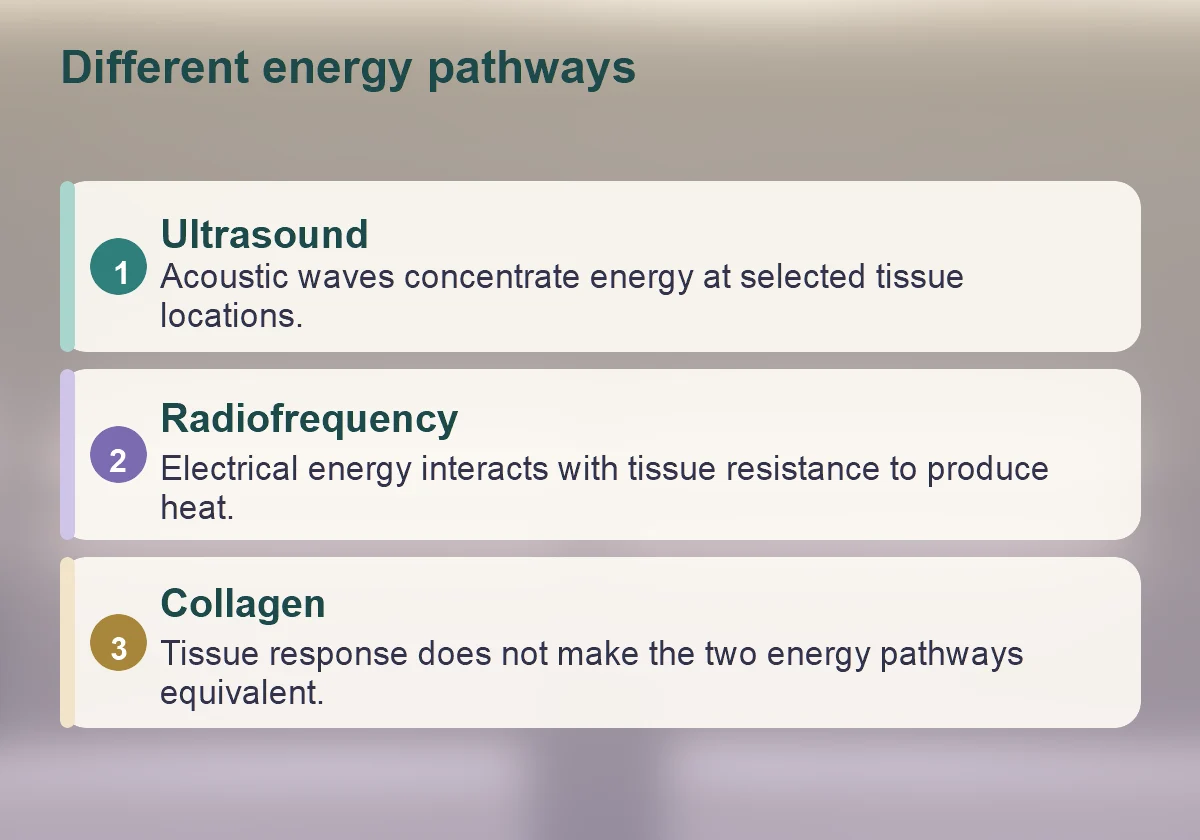
In focused ultrasound, acoustic energy is concentrated at selected locations beneath the skin. The FDA technical description of the Ulthera System, one microfocused ultrasound system, describes discrete points of thermal coagulation and tissue contraction. Coagulation here means a controlled tissue change caused by heat. It does not mean that the whole skin is heated uniformly.
HIFU means high-intensity focused ultrasound. Microfocused ultrasound also belongs to the focused-ultrasound discussion, but the names do not make every device identical. A description of Ulthera is an example of a particular system, not a specification sheet for all HIFU equipment.
RF instead delivers electrical energy to tissue. Tissue resistance and impedance, terms describing the tissue's electrical response, matter to its heating profile. The manufacturer's manual says the Thermage CPT system monitors impedance and explains that changes in electrical resistance can change tissue heating. This is a different physical pathway from concentrating acoustic waves.
Compare the pathway, not a promised outcome
| Question | Focused ultrasound | Radiofrequency |
|---|---|---|
| What carries the energy? | Acoustic waves | High-frequency electrical energy |
| What creates the thermal response? | Focused acoustic energy deposited in tissue | Electrical energy interacting with tissue resistance and impedance |
| What can feedback describe? | Some systems provide tissue imaging | Some systems monitor electrical measurements such as impedance |
| What still needs checking? | The exact model and its imaging capability | The exact model, its feedback and any imaging capability |
This comparison explains energy delivery, not which treatment is stronger, safer or more effective. An energy category does not identify an individual's treatment plan.
What does collagen remodelling mean here?
Collagen language describes tissue biology after energy delivery, rather than the energy itself. Ultherapy's manufacturer describes heat-related collagen denaturation, new collagen synthesis and subsequent maturation and remodelling. Denaturation means a change in the protein's structure; synthesis means making new collagen. These are connected stages, not another name for ultrasound waves.
The Thermage CPT manual also discusses improvement in collagen structure among treatment expectations. That shared interest in collagen does not demonstrate equal results or make the delivery methods equivalent. A mechanism explains a process; it does not guarantee how much visible change any person will experience.
Imaging belongs to the model, not the energy name
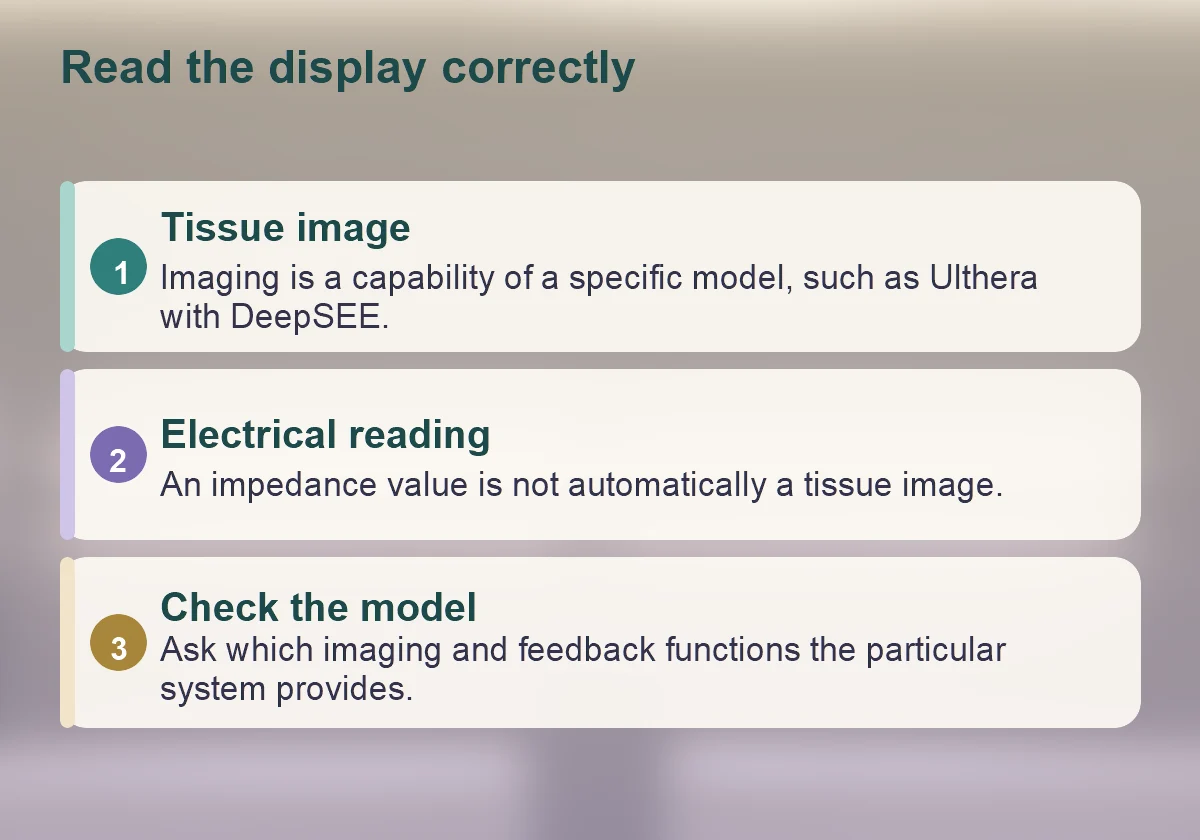
The Ulthera description identifies supplemental imaging with DeepSEE to help visualise tissue, assess coupling between the transducer and skin, and confirm an appropriate treatment location. Producing a treatment wave and producing an image are distinct functions. A visualised depth should not be read as the depth at which all treatment energy is delivered.
Likewise, an impedance reading on an RF display is an electrical measurement, not automatically a picture of tissue. It would also be incorrect to conclude that every RF system lacks imaging. Check what the particular system actually provides.
- Ask for the exact device and model name.
- Ask whether its display shows tissue imaging, numerical feedback or both.
- Ask what that information helps the operator confirm during treatment.
Frequently asked questions
Is ultrasound energy the same as RF energy?
No. Ultrasound carries acoustic energy; RF delivers electrical energy in the radiofrequency part of the electromagnetic spectrum. Both can generate tissue heat without being the same technology.
Does every HIFU device provide live imaging?
Do not assume so. The imaging described for Ulthera and DeepSEE is a model-specific capability. Check the documentation for the system being discussed.
Does mentioning collagen mean the results are equivalent?
No. Collagen describes part of the tissue response. It does not establish equivalent outcomes, suitability or a universal treatment depth.
Sources
- FDA: Ulthera System technical description
- Solta Medical: Thermage CPT technical manual
- FDA: RF energy classification in a device summary
- Ultherapy: collagen mechanism of action
Questions before your visit?
For treatment enquiries and appointment requests, message us on WhatsApp with the treatment you are considering and your preferred visit date.
Individual results may vary.
Back to Blog →